
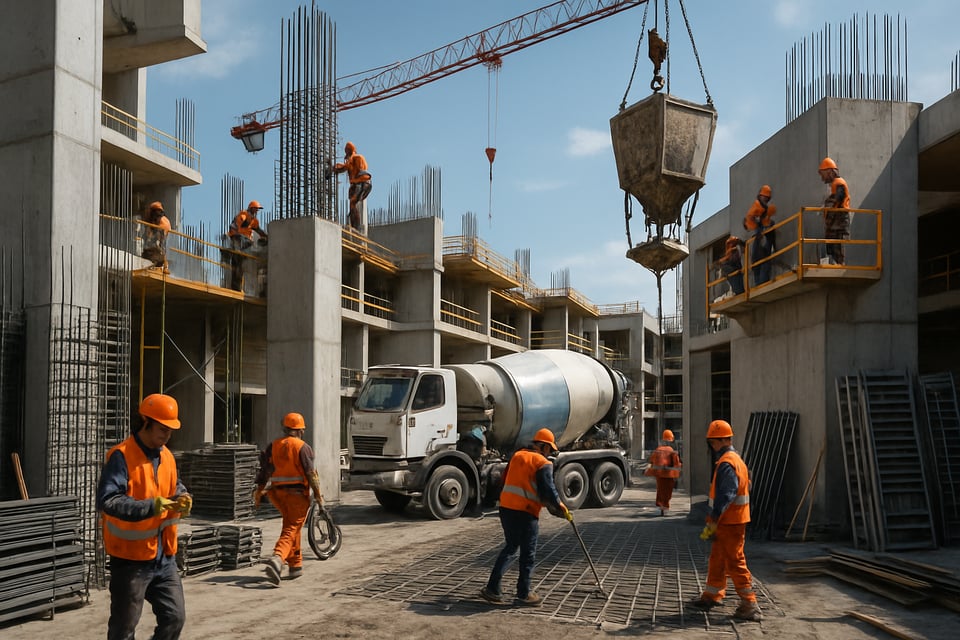
6 mars 2026 Every cubic meter of concrete counts. At Swerock, part of the PEAB Group in Sweden,...
Understanding What Really Drives the Transition
Carbon Neutral. Net Zero. Zero Emissions.
Do you really know the difference, and why it matters for the construction and concrete sectors?
The language of sustainability now defines strategy, compliance, and competitiveness.
What once sounded aspirational has become a technical battlefield where definitions and data decide credibility.
In our previous article, we explored the shift from gross to net emissions in Environmental Product Declarations (EPDs) – a regulatory trend that highlights how measurement itself is evolving. That shift is part of a broader transformation: sustainability claims must move from slogans to data-driven accountability.
For leaders in construction and concrete, ambition alone is no longer enough. The words you use, and the data behind them, can determine whether you win bids, attract investors, or risk being accused of greenwashing.
What the Terms Really Mean
- Carbon Neutral
Companies continue to emit but balance their footprint through offsets (e.g., carbon credits). It’s often a first step, but limited without deep emission reductions. - Net Zero
Represents measurable reductions across operations and supply chains, with offsets only for what’s technically unavoidable. It signals structural change, not financial compensation. - Zero Emissions
The most ambitious goal – eliminating emissions altogether. In construction and concrete, this requires breakthroughs like alternative binders, carbon capture, circular materials, and new design paradigms.
These distinctions might seem subtle, but they represent vastly different levels of ambition and credibility. In the carbon neutral vs. net zero discussion, imprecision isn’t harmless – it’s costly.
The Regulatory Shift You Can’t Ignore
Across Europe, rules are tightening – and every sustainability claim must now be verifiable:
- CSRD mandates data-backed climate disclosure.
- EU Taxonomy limits what can legally be marketed as “sustainable.”
- Public procurement in Sweden increasingly demands EPD-supported documentation.
- And the gross → net evolution in EPDs shows that even the industry’s own tools are becoming more rigorous.
Vague pledges no longer pass scrutiny. Every figure should be defensible, every claim supported by lifecycle-based data.
Why Leaders Can’t Afford Ambiguity
The construction sector accounts for nearly 40% of global CO₂ emissions, and concrete alone contributes around 7%. Regulators, clients, and investors are watching closely.
Companies that overstate or misuse terms risk:
- Reputational damage from perceived greenwashing
- Regulatory exposure when standards tighten
- Lost bids where sustainability scores matter
The challenge isn’t intent, it’s execution. Bridging ambition with actionable, credible data is where most companies stumble.
Common Pitfalls to Avoid
- Overreliance on offsets without a credible reduction strategy
- Scope 3 blind spots, even though supply chains dominate emissions
- Mislabeling projects as “Net Zero” that are merely “Carbon Neutral”
- Isolated “flagship” projects that never scale across portfolios
Building Credibility in Climate Strategy
From our perspective, credible climate strategies in construction share four traits:
- Ground targets in real data
Without LCAs and verified EPDs, numbers are arbitrary. - Prioritize reduction over compensation
Stakeholders expect material substitution, process improvements, and design changes before offsets. - Align with recognized frameworks
Standards like SBTi help convert ambition into measurable pathways. - Be radically transparent
Define scope, boundaries, and assumptions. Ambiguity erodes trust.
From Buzzwords to Better Decisions
The industry doesn’t need another slogan. It needs clarity, speed, and efficiency in handling sustainability data.
That’s where Ecometrix comes in. Our platform, Cicero, processes and validates hundreds of EPDs every week. Using AI-enhanced data processing, Cicero turns fragmented, inconsistent environmental data into searchable, comparable, and decision-ready insights.
For construction leaders, this means:
- Simplicity – a single, intuitive source of truth instead of scattered spreadsheets.
- Speed – answers in seconds, not weeks of manual review.
- Cost-efficiency – lower overhead and faster project workflows.
Most importantly, we design our tools not just to report, but to support business processes and decisions. Better data enables smarter sourcing, stronger bids, and products that deliver performance with a lower environmental impact.
The Road Ahead
The move from gross to net in EPDs is only the beginning. Regulations will keep tightening; clients will demand transparency; and leaders will be pressed to prove, not just promise, progress.
The companies that wins will:
- Integrate sustainability into their day-to-day processes.
- Use high-quality, AI-enhanced data to guide choices.
- Deliver measurable results, not just marketing language.
At Ecometrix, our mission is to make that possible, so “Carbon Neutral,” “Net Zero,” and “Zero Emissions” become outcomes grounded in real action.
Because the future of construction won’t be won by the loudest slogans, but by the clearest data—and the strongest results.


